Pages

Friday, August 27, 2010

Clipper Ships


“Never, in these United States,” wrote historian samuel Eliot Morison, “has the brain of a man conceived, or the hand of man fashioned, so perfect a thing as the clipper ship.”
The word “clip,” which meant simply “to cut”, later came to mean “to move quickly”.” So a clipper ship was a fast-sailing one.

Clipper ships were the fastest and most beautiful sailing ships ever built. Between 1845 and 1859, American shipyards produced nearly 500 of them. The speediest were the giant Yankee clippers. With their masses of sail, these long, slender ships could travel up to 400 nautical miles a day.

Clippers were first built to carry goods to and from China. After the discovery of gold in California in 1848, they carried prospectors and supplies from the East Coast, to the gold fields. Earlier, this 15,000-mile trip around the southern tip of South America took five months. But by the early 1850s speedy clippers such as the Flying Cloud had cut the time to three months. Clippers set other records, too. In 1849, the Sea Witch sailed from Hong Kong to New York in 74 days. In 1852, the Challenger raced from Japan to California in 18 days. And in 1860, the Andrew Jackson sailed from New York to Liverpool, England, in 15 days. But by then steamships, which did not depend on wind, were replacing the clippers. The era of these “greyhounds of the sea” were coming to a close.

Tuesday, August 24, 2010

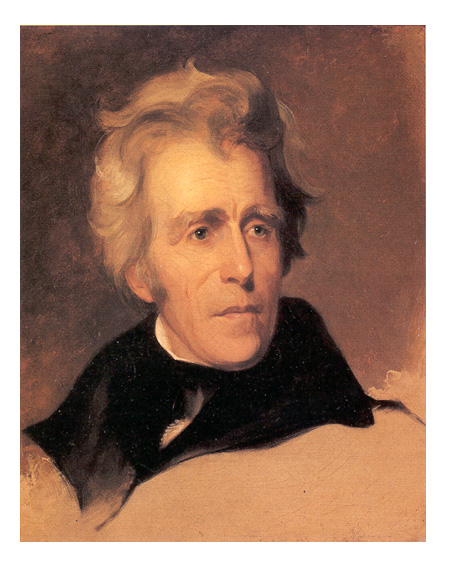
Andrew Jackson

Andrew Jackson was called “Old Hickory” by the soldiers he commanded. Like the hickory tree, he was strong and tough. But his soldiers loved him, and so did the American people.

Born in the backwoods log cabin. Jackson fought in the Revolutionary War when he was only 13. When he was 14, Andrew Jackson refused to shine the boots of a British officer. The officer slashed him with his sword, leaving a permanent scar on Jackson’s head.

As a young lawyer he moved to Nashville, Tennessee, where he became a cotton planter, a Congressman, and a militia officer. During the War of 1812 against Britain, he commanded the victorious American troops at the Battle of New Orleans. That triumph made Jackson a national hero. Although he narrowly lost the presidential election of 1824, he won easily four years later.

During his eight years in the White House, Jackson used his powers to strengthen the national government and improve the lives of ordinary Americans. He firmly opposed those who believed that individual states could nullify (cancel) laws they didn’t like. He fought against the Bank of the United States, which he thought favored the rich. And he vetoed many bills that seemed to him to be undemocratic. Because he fought for the average man against the wealthy, Andrew Jackson was known as “the people’s president.”

Monday, August 23, 2010

Colorado


In 1806, Zebulon Pike journeyed west to explore the vast territory the U.S. had bought from France in the Louisiana Purchase. Crossing the Great Plains into present-day Colorado, he reached the spectacular Rocky Mountains and the snow-covered mountain that now bears his name, Pikes Peak.

More than 50 years later, gold was discovered nearby. Thousands of propectors set out for the region, determined to reach “Pikes Peak or bust.” Loggers, ranchers, and farmers followed the miners to Colorado, which became a territory in 1861 and achieved statehood in 1876.


Today, 80 percent of Colorado’s residents live in the central part of the state, in a band of rolling hills along the edge of the Rockies. Denver, the capital and largest city, is there. The area boasts comfortable summers and cold, unusually sunny winters, periodically broken by the famous “Chinook” wind. A hot dry Chinook, gusting down from the mountains, can raise temperatures 30 to 40 degrees in an hour. Many of Colorado’s old gold-and silver-mining towns are now ghost towns, but mining remains important in the economy as do ranching, farming, and manufacturing. So is tourism.

Colorado is famous for its dramatic scenery, splendid national parks and forests and glamorous ski resorts such as Vail and Aspen.

Colorado, the highest state, has an average elevation of 6,800 feet.

Monday, May 31, 2010

Memorial Day-2010

Today we honor and remember.....


Outside a broad downright rots the laughing luxury.

Saturday, March 13, 2010

Cowboys and Cattle Drives

At the end of the Civil War, there were five million cattle in Texas, but the market for them was in the North and East. A steer worth $4 in Texas could be sold for $40 in those markets - if the cattleman could get the steer there. So Texas ranchers began using “cowboys” to drive their herds north to “cowtowns” on the railroad in Kansas. The great cattle drives began in 1866 and went on for 20 years. Their routes became famous: the Western Trail, the Loving Trail, and the Chisholm Trail. At the cowtowns – Abilene, Ellsworth, Wichita, Dodge City – the steers were loaded aboard trains and sent to market.

Cattle drives were hard and dangerous work. Herds could be stampeded by lightening or thunder. There were flooded rivers to cross, but in dry times water was scarce. Cowboys had to guard against Indians and rustlers. The cowboys took their meals at the chuck wagon and at night slept under the stars. But in the end of the drive they could “cut loose”. In Dodge City, a cowboy wrote, “glasses clinked, dice rattled….violins, flutes, and cornets sent eager strains of waltz and polka…As the night sped on, the saloons became clamorous with….songs and laughter.”

The largest cattle drive on record took place in 1869, when 200 cowboys set out for Texas with a herd of 15,000 steers.

Sunday, March 7, 2010

Stonewall Jackson

Stonewall Jackson died two years before the end of the Civil War, but he is remembered as one of the greatest commanders. He was Robert E. Lee’s right-hand man, famous for this brilliant tactics and bold strikes against Union forces.

Jackson was a graduate of the U.S. Military Academy at West Point. He was promoted for bravery three times during the War with Mexico. He did not approve of slavery, but he was loyal to his home state, Virginia, and joined the Confederate Army when the Civil War broke out. He earned his nickname at the Battle of Bull Run in 1861. As his brigade withstood a Union onslaught, a fellow officer called out, “There is Jackson, standing like a stone wall.” Jackson next led a brilliant campaign in the Shenandoah Valley.

Although greatly outnumbered, he held off the Union force with a series of lightning strikes and well-fought encounters. He fought some of the war’s most important battles. In May, 1863, he won his greatest victory, at Chancellorsville, Virginia. But the battle had a tragic aftermath. Returning home from a scouting mission, he was mistaken for an enemy and shot by his own men. Jackson died eight days later. It was a bitter loss for Lee, who mourned, “I know not how to replace him.”

Jackson observed the Sabbath so strictly that he would not write a letter if he thought it might travel in the mails on Sunday.

Johnstown Flood

In 1889, Johnstown, Pennsylvania, was a busy little city on the Conemaugh River, about 60 miles east of Pittsburgh. In the 1850s, the state had constructed an earthern dam north of the town, on a tributaryof the river. A body of water, Conemaugh Lake, had formed behind the dam. Because people wanted to enlarge the lake for fishing, the dam was made higher – but unfortunately not stronger.

Heavy rains fell throughout the spring of 1889, raising every river and stream about flood stage. Then, on the afternoon of May 31, disaster struck. The dam suddenly gave way, and the waters of Conemaugh Lake roared down the narrow river valley. A wall of water – traveling at 40 miles an hour and carrying with it huge boulders, whole trees, and other wreckage – smashed everything in its path. Farms, factories, and most of Johnstown itself were swept away. For most victims, the only warning was the thunder of the water advancing upon them. Sixty acres of wreckage piled up against a bridge below Johnstown. Broken oil-tank cars exploded, setting fire to the rest of the wreckage, which burned for days. The Johnstown Flood killed more than 2200 people. IT was was one of the worst Amerivan disasters in the nineteenth century.

Because the lake at Johnstown had been enlarged for fishing, one writer summed up the flood in these words: “All the horrors that Hell could wish, such was the price that was paid for fish.”