In 1814, America had been at war with Great Britain for two years. The War of 1812 had begun largely because of British interference with American trade. During 1814, American army and navy forces won several battles that eventually brought peace between the two countries. But the most dramatic event of the war occurred in 1814 with the British attack on America’s capital city, Washington.
In August, 1814, a British force landed in Maryland, scattered the weak American forces there, and on August 24, marched into Washington. President James Madison and other government officials fled the city. Before she left, First Lady Dollley Madison rescued the portrait of George Washington that hung in the White House.
British General Robert Ross ordered Washington’s public buildings to be burned. The British piled furniture up in the White House’s drawing room and set it afire; the inside of the mansion was gutted. The Treasury and War Department buildings were burned next. When the British set fire to the Capitol, it’s interior was destroyed and its roof collapsed. Repairs to Washington took years. Not until 1819 was Congress able to meet again in the the Capito..
The only government building in Washington not burned in 1814 was the patent office; it’s precious drawings and models were sparred.
Showing posts with label War of 1812. Show all posts
Showing posts with label War of 1812. Show all posts
Tuesday, September 14, 2010


Tuesday, August 24, 2010
Andrew Jackson
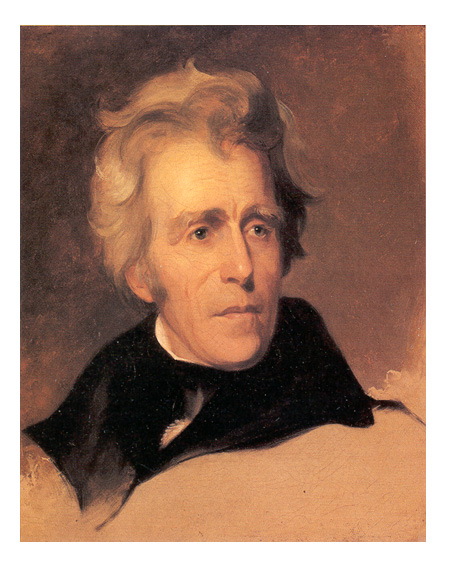
Born in the backwoods log cabin. Jackson fought in the Revolutionary War when he was only 13. When he was 14, Andrew Jackson refused to shine the boots of a British officer. The officer slashed him with his sword, leaving a permanent scar on Jackson’s head.
As a young lawyer he moved to Nashville, Tennessee, where he became a cotton planter, a Congressman, and a militia officer. During the War of 1812 against Britain, he commanded the victorious American troops at the Battle of New Orleans. That triumph made Jackson a national hero. Although he narrowly lost the presidential election of 1824, he won easily four years later.
During his eight years in the White House, Jackson used his powers to strengthen the national government and improve the lives of ordinary Americans. He firmly opposed those who believed that individual states could nullify (cancel) laws they didn’t like. He fought against the Bank of the United States, which he thought favored the rich. And he vetoed many bills that seemed to him to be undemocratic. Because he fought for the average man against the wealthy, Andrew Jackson was known as “the people’s president.”
Sunday, December 28, 2008
Johnny Appleseed
When Americans bite into crisp, fresh-picked apples or slices of apple pie, they should thank John Chapman. No one did more to encourage the cultivation of apple orchards during America’s frontier days. Chapman’s efforts made him a legendary folk hero and earned him the nickname “Johnny Appleseed.”
Each fall during cider-making time, Chapman collected seeds from the sweet-smelling cider presses. He carefully washed them, and dried them in the sun. Then he planted the seeds in forests and fields. For more than 40 years, beginning in the late 1700s, Chapman crisscrossed Pennsylvania, Ohio, and Indiana, tending his budding apple trees and showing people how to start their own orchards.
Dressed in tattered clothes, he cheerfully endured the hardships of pioneer life. People thought him odd, but praised his friendliness and sincereity. However, during the War of 1812, John Chapman saved the hamlet of Mansfield, Ohio, by summoning troops to defend it against a Native American attack.
Not much is known about John Chapman’s life. But as Johnny Appleseed, the sower of tiny seeds that grew into stately orchards, he holds a unique place in American frontier history.
Subscribe to:
Posts (Atom)